
Dunchurch Boughton CofE Infant Academy and Nursery
Reading and Phonics
Phonics
At Dunchurch Boughton C of E Infant Academy and Nursery, our approach to reading and phonics is rooted in our Christian vision, ‘Roots to Grow, Wings to Fly’, inspired by the Parable of the Mustard Seed. We believe that learning to read provides children with strong foundations from which they can grow, flourish and develop a lifelong love of reading. Through nurturing a love of books, stories and language, we aim to give every child the wings to explore new worlds, develop their imagination and embrace future learning opportunities with confidence.
We use Little Wandle Letters and Sounds Revised to teach phonics throughout Nursery, Reception and Year 1. This systematic, structured approach features on the Department for Education's list of validated phonics schemes and takes account of current research into cognitive science. Phonics teaching is carefully sequenced, consistent and well-paced to ensure that children quickly develop the knowledge and skills needed to become confident, independent readers. Children systematically learn sounds and tricky words, developing an understanding that sounds can be represented by graphemes (the written representation of sounds) and learning how to blend these sounds together to read words. This carefully structured approach enables children to begin reading words and sentences from the earliest stages of their phonics journey, sometimes after learning just their first four sounds. Through high-quality teaching, regular practice and a rich reading environment, we ensure that every child develops the essential foundations to become a fluent, enthusiastic and confident reader.
It is very important that phonemes (letter sounds) are pronounced correctly by the children, so that they don't encounter problems when blending to read words. Please see the links below to view the pronunciation of sounds:
Phase 2 sounds taught in Reception Autumn 1
Phase 2 sounds taught in Reception Autumn 2
This Phase 2 sounds taught in Reception Autumn 2 video is designed to be shared with families to help them to support learning at home.
Phase 3 sounds taught in Reception Spring 1
This Phase 3 sounds taught in Reception Spring 1 video is designed to be shared with families to help them support the learning at home.
Children in reception are quickly taught to blend graphemes to read words. You can see how we teach children to blend by viewing the video.
Within the phonics lessons, children are also taught how to read 'tricky words'. These are words that, at the time of teaching, are not yet phonetically decodable. This video demonstrates how we teach tricky words in school.
Children’s phonics knowledge across the school is assessed half termly in order to inform teachers planning and to check all children are making progress. Those children who need support to keep up with their peers will receive interventions that may involve them working in a small group or individually with a designated adult.
At the end of year 1, children take part in the national phonics screening check. Children are asked to read forty words, some of which are alien words. The national expected level is typically to read thirty two out of forty words correctly. Children who did not reach the expected level will receive ongoing phonics support as they move into year 2 and will take the phonics screening again a year later.
Quick guide to Alien words
This Alien words video is designed to be shared with families by schools using the Little Wandle Letters and Sounds Revised complete phonics programme to help them to support learning at home.
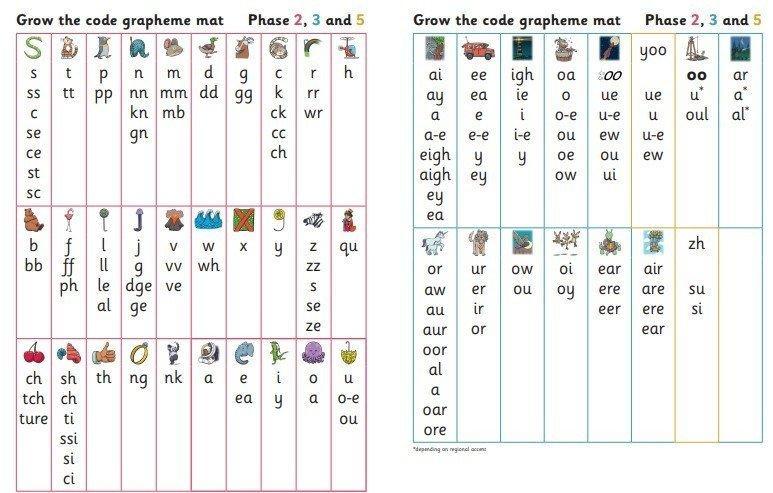
The full range of graphemes taught to the children within their phonics lessons in reception and KS1 can be seen in the chart below:
Reading
Learning to read is a key life skill. By the end of year 2, our children should be confident to select and tackle a wide range of age appropriate literature, including fiction, non-fiction and poetry texts.
Reading lessons (reading practice) take place in reception, year 1 and year 2 three times per week, in differentiated ability groups, focussing on:
- decoding practise
- reading with prosody (reading with feeling and expression)
- comprehension (taking part in book talk, predicting, making inferences and deductions, exploring vocabulary, stating personal opinions and retrieving information from the text)
Reading at home:
Your child will be taught to read whilst at school, but you can have a huge impact on their reading journey by continuing their practice at home. There are two types of reading books that your child will bring home:
1. A reading practice book – this will start to be sent home from reception and will continue throughout year 1 and year 2. Our reading practice books in reception and year 1 are from the Big Cat Collins reading scheme. The books are fully decodable and are aligned to our phonics progression. The book sent home will be at the correct phonic stage for your child. They should be able to read this book fluently and independently. If your child is reading the book with little help, please don’t worry that it’s too easy, your child needs to develop fluency and confidence when reading. Listen to them read the book and remember to give them lots of praise – celebrate their success! If they can’t read a word after attempting to sound it out and blending, read it to them. After they have finished reading, talk about the book together.
Children will remain reading the Big Cat Collins reading books aligned to the phonics progression until they are secure with the phonics expectations at the end of the first half of the autumn term in year 2. For some children, this may mean that they continue reading the Big Cat Collins books linked to the phonics progression further into their year 2 year.
Once children have achieved the expectations in the phonics progression, they progress onto reading books which contain more complex sentences and vocabulary within the Big Cat Collins scheme.
2. A sharing book – all children throughout school will bring home a sharing book, including nursery. In order to encourage your child to become a lifelong reader, it is important that they learn to read for pleasure. The sharing book is a book they have chosen for you to enjoy together. Please remember that you shouldn’t expect your child to read this alone. Read it to or with them. Discuss the pictures, enjoy the story, predict what might happen next, use different voices for the characters and explore the facts in a non-fiction book. The main thing is that you have fun!
Our progression maps linked to reading and phonics can be found below.